TheFarmersDigest
The Farmers Digest
Jul 8, 2025
Author
Chris Pigge
Editor
Miles Falk
Adding Livestock to Your Row Crop Operation: A Farmer's Guide to Making the Decision
A note from the editor (Chris Pigge):
One of the most exciting developments in row crop operations has been the integration of livestock with crops. Whether grazing crop residue, cover crops, or fields out of rotation for a season, having livestock creates income diversification for row crop farmers while providing many other benefits: using livestock to terminate cover crops, fertilize the land, and utilizing land that would typically sit idle for half the year.
While not a requirement for farmers implementing livestock, the direct-to-consumer approach has real potential. Farmers can insulate themselves from commodity markets by essentially creating their own micro-market. If you sell beef with a profit of $3,000 per cow (I know farmers doing this) and you raise 50 cows, that's $150,000 in additional profits annually. Of course, it's not that easy and success depends on your operation, but many farmers are doing this with great results. This article should help shed some light on how you can get started implementing livestock with your row crop operation.
If you want me to cover something else or have questions feel free to shoot me an email at chris@farmtofork.life
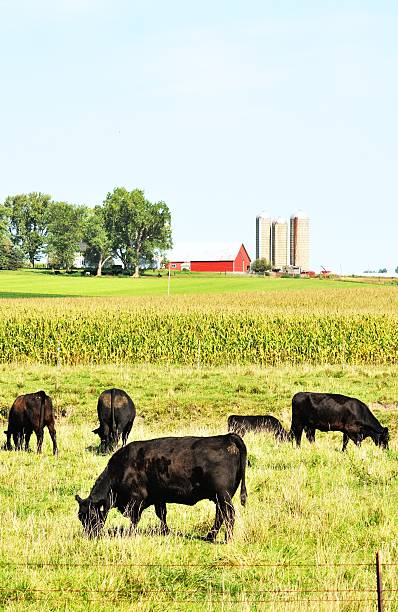
You grow corn and beans. You've got the systems down, the equipment paid for, and a rhythm that works. Then you start hearing about farmers adding cattle to their crop ground, grazing cover crops, and supposedly making money doing it. Sounds interesting, but is it right for your operation?
The truth is, integrating livestock into row crop systems can transform your farm's profitability and resilience—or create an expensive headache that makes you wish you'd never heard the word "cow." The difference lies in understanding what you're getting into before you make the leap.
The Real Question: Does This Fit Your Operation?
Before diving into the how-to details, ask yourself the fundamental questions that determine whether livestock integration makes sense for your farm:
Do you have adequate acreage? A few head of cattle can work on smaller operations, but livestock integration typically needs scale to justify the infrastructure and labor. Most successful operations run livestock on at least 100-200 acres, though innovative systems work on smaller scales.
Can you handle more daily work? Crops need attention during planting and harvest. Livestock need attention every single day, all year long. Adding animals means someone checks water, fixes fence, and monitors animal health regardless of weather, holidays, or harvest deadlines.
What's your risk tolerance? A $2,000 cow can die just as easily as a $200 sheep. Livestock add biological risk that doesn't exist in crop-only operations. Equipment breaks—you fix it. Animals get sick or die—you absorb the loss.
How are your people skills? If you're buying livestock, you're dealing with livestock people. If you're selling meat, you're dealing with consumers or packers. The hermit farmer who avoids phone calls might struggle with the relationship-intensive aspects of livestock marketing.
The Money Question: Multiple Ways to Make This Pay
The financial appeal of livestock integration works through several channels, and different operations emphasize different profit centers:
Land Utilization That Actually Pays
Your corn ground sits idle from October through April—roughly 200 days per year. That's expensive real estate generating zero income for more than half the year. Livestock can graze cover crops, crop residues, and winter forages during these dormant periods, converting maintenance costs into revenue streams.
A simple example: Plant winter triticale after corn harvest, graze it with cattle from February through April, then plant soybeans. The cattle pay for the cover crop seed while providing fertility for the beans. Instead of spending money on soil improvement, you're generating income from it.
Fertilizer Replacement That Compounds

Every pound of nitrogen livestock deposit through manure is a pound you don't buy. But the benefits compound beyond simple nutrient replacement. Research from Dr. Douglas Edmeades, a New Zealand soil scientist and former National Science Leader for Soils and Fertiliser at AgResearch, shows that manure applications increase soil organic matter and microorganisms while improving soil structure—benefits that synthetic fertilizer alone cannot provide.
The fertility value depends on stocking density and timing, but conservative estimates suggest 50-70 pounds of nitrogen per acre annually from properly managed grazing systems. At current fertilizer prices, that's $30-50 per acre in avoided costs, before considering phosphorus, potassium, and micronutrient contributions.
Risk Spreading That Makes Sense
Single-enterprise operations live and die by one commodity's performance. Bad corn prices can devastate a corn-only operation. Integrated systems spread risk across multiple markets and provide flexibility to adapt when conditions change.
When grain prices are strong, sell the grain. When cattle prices are high, background more calves. When both markets are weak, use crop failure insurance while livestock graze damaged crops. This flexibility provides options that specialized operations don't have.
Value-Added Marketing Opportunities
Integration opens marketing channels that pure commodity operations can't access. Grass-finished beef, grain-fed beef from farm-grown corn, pastured lamb, and free-range eggs command premium prices in direct markets. Some producers report retail prices of $8-12 per pound for grass-finished beef compared to $4-6 for conventional beef at retail, with grain-fed direct sales often falling in the middle of that range.
However, direct marketing requires different skills and substantial time investment regardless of finishing method. You're not just farming—you're running a retail business with all the customer service, marketing, and logistics that entails.
Three Levels of Integration: Pick Your Complexity
Livestock integration isn't all-or-nothing. Different approaches require different commitments and offer different returns:
Level 1: Contract Grazing - Testing the Waters
The lowest-risk entry involves bringing someone else's livestock to graze your cover crops or crop residues. You provide land and water; they provide animals, fencing, and daily management.
This approach lets you learn about animal behavior and grazing management without owning livestock or investing in major infrastructure. Many operations start here to test the concept before committing to ownership.
Contract rates vary by region and forage quality, but $0.50-1.50 per head per day is common for cover crop grazing. On 100 acres with 50 head for 60 days, that's $1,500-4,500 in revenue for forage that would otherwise be terminated mechanically.
Level 2: Ownership with Simple Systems
Owning livestock allows capture of the full economic value but requires infrastructure and management commitment. Simple systems focus on ease of management rather than maximum efficiency.
A basic approach might involve 30-50 head of cattle grazing cover crops and crop residues using temporary electric fencing and portable water tanks. Animals stay in larger paddocks for longer periods, reducing daily labor while still providing integration benefits.
This level requires investment in fencing ($500-2,000 depending on scale), water systems ($1,000-5,000), and livestock purchase ($40,000-100,000 for a modest herd). However, the infrastructure spreads across many acres, and livestock can be sold if the system doesn't work out.
Level 3: Intensive Rotational Systems
High-intensity systems maximize the biological and economic benefits through frequent moves and careful grazing management. Animals might move daily or every few days, requiring sophisticated fence and water systems.
These operations often achieve the highest per-acre returns but demand significant labor and management expertise. Daily moves require reliable systems and consistent attention regardless of other farm activities.
Gabe Brown's North Dakota operation exemplifies this approach, with cattle moving through diverse cover crop mixtures that provide grazing from October through January while building soil health for subsequent crops.
Species Selection: Different Animals, Different Games
The choice of livestock species affects everything from infrastructure costs to marketing channels to daily management requirements:
Cattle: The Commodity Play
Cattle offer the simplest entry point for most row crop operations. They're familiar to most farmers, easy to contain with basic fencing, and have established commodity markets through sale barns and direct sales to feedlots.
A 1,200-pound cow is harder to lose than a 120-pound sheep. Cattle respect electric fence reliably once trained, and predator losses are minimal except in areas with wolves or bears.
However, cattle represent higher financial risk—a dead cow costs $1,500-2,500 compared to $150-300 for a sheep. Cattle also require stronger fencing and handling facilities compared to smaller livestock.
Sheep and Goats: Higher Returns, Higher Management
Small ruminants offer advantages for smaller operations or specific grazing objectives. They're cheaper to purchase initially, can graze areas cattle can't access, and often bring higher prices per pound in direct markets.
Sheep work well for cover crop termination and browse control. They can graze closer to the ground than cattle and will eat many weeds that cattle avoid. A flock of 100-200 ewes can provide substantial income on modest acreage.
The downside involves predator pressure, escape tendencies, and more complex marketing. Sheep and goats require predator protection in most areas, adding infrastructure costs and management complexity. Marketing often involves ethnic markets, direct sales, or specialized processors rather than commodity channels.
Poultry: Niche Opportunities
Pastured poultry can work well in integrated systems, particularly for pest control and residue cleanup. Chickens following cattle can break parasite cycles while consuming fly larvae and weed seeds.
However, poultry require daily attention for feed, water, and predator protection. Mobile housing systems allow rotation but add labor and equipment costs. Marketing typically involves direct sales or local processing.
Pigs: Maximum Impact, Maximum Risk
Pigs provide exceptional soil tillage and can utilize crop failures or damaged grain that other livestock cannot handle. They're efficient converters of grain to meat and can access premium markets for pastured pork. Joel Salatin of Polyface Farm has demonstrated the potential, producing premium pork that sells for $8-10 per pound at high-end restaurants.
Pigs excel at land clearing projects, eating roots and removing vegetation that other livestock won't touch. They can convert brushy or overgrown areas into usable ground while producing valuable meat. This dual-purpose capability makes them attractive for operations with rough ground that needs improvement.
However, pigs are absolutely no joke on pasture and can utterly destroy productive land faster than any other livestock. They're the most dangerous animal to turn out on good ground without proper knowledge and management systems.
Pigs can devastate an area in days, not weeks. Their rooting instinct is incredibly powerful, and they will turn productive pasture into what looks like a plowed field if overstocked or left too long in one area. Unlike cattle that primarily graze, pigs actively work the soil, which can be either beneficial soil tillage or complete destruction depending on timing, stocking rate, and land conditions.
You absolutely must start small and learn the system before scaling up. Even experienced farmers report significant learning curves with pastured pigs. The infrastructure requirements are more demanding than other livestock—pigs are escape artists that require robust fencing and consistent feed supplies. They also need careful management to prevent crop damage and neighbor relations problems.
But when managed correctly, the benefits can be huge. Pigs can convert damaged crops, processing waste, and rough ground into premium meat while providing valuable soil improvement services. The key is understanding that this takes real skill and patience to master.
Infrastructure Reality Check: What It Actually Costs
The infrastructure requirements for livestock integration vary dramatically based on approach and ambition, but all systems require basic fencing, water, and handling facilities:
Fencing: From Basic to Bulletproof

A scrappy operation might start with $400 worth of polywire and posts, using existing perimeter fencing for containment. This approach works for simple systems with moderate-sized groups of cattle.
For row crop integration, all internal fencing must be temporary and removable since tractors need full field access for planting, cultivation, and harvest. This actually simplifies the fencing equation—polywire systems moved with step-in posts work perfectly and cost much less than permanent infrastructure.
More intensive systems require more sophisticated temporary fencing that moves easily but contains animals reliably. However, this cost spreads across many acres and the equipment lasts for years with proper care.
Electric fencing works well for most livestock integration, particularly temporary systems that allow flexible paddock configuration. Solar chargers eliminate the need for electrical connections and provide reliable power for remote areas.
Water: The Make-or-Break Infrastructure
Adequate water access determines the success or failure of any livestock operation. Animals need constant access to clean water, and poor water placement kills more grazing systems than any other factor.
Simple systems might use portable tanks moved with tractors or ATVs. This approach works but requires daily labor and limits paddock flexibility. Permanent water systems with multiple access points provide more flexibility but require higher initial investment.
Cattle drink 25-30 gallons daily in hot weather, so a 50-head herd needs 1,250-1,500 gallons daily. Size water systems accordingly, with 20% extra capacity for safety.
Handling Facilities: Safety and Efficiency
Even extensive grazing systems need basic handling facilities for loading, sorting, and veterinary care. Permanent facilities cost $5,000-15,000 but last decades and improve both safety and efficiency.
Portable handling systems offer flexibility for operations that graze multiple locations. These systems cost less initially but require more labor to set up and move.
Marketing Reality: Know Your Options Before You Start
Without buyers for both your grain and your livestock, the best integration system in the world won't pay the bills. This doesn't necessarily mean premium markets—livestock can go to the sale barn and grain to the elevator just like any other operation. However, some producers pursue direct marketing to capture higher prices, which requires developing skills in customer education, product presentation, and relationship building that differ significantly from traditional farming.
Commodity Marketing: The Path of Least Resistance
Most livestock from integrated systems can access commodity markets through sale barns, order buyers, or direct sales to feedlots. These markets require minimal marketing skills beyond basic livestock knowledge and timing.
Commodity prices fluctuate, but the markets are reliable and handle large volumes efficiently. This approach works particularly well for cattle operations that want to focus on production rather than marketing.
Direct Marketing: Higher Prices, Higher Effort
Direct-to-consumer marketing can capture higher prices but requires different skills and significant time investment. Successful direct marketers educate customers about production methods, maintain consistent quality, and build relationships that go beyond simple transactions.
Direct marketing works well for operations near population centers with customers willing to pay premium prices for locally produced food. However, it requires facilities for processing, storage, and distribution that add complexity and cost.
Niche Markets: Matching Production to Demand
Ethnic markets, restaurants, and specialty retailers offer opportunities for producers willing to meet specific requirements. These markets often pay premium prices and may have less competition than mainstream commodity channels.
Research your local market opportunities before choosing livestock species or production methods. A thriving Somali community might create strong demand for goat meat, while an area with many Mexican restaurants might prefer specific cuts of beef or lamb. These consumers buy meat just like anyone else—the key is understanding what products they prefer and how they like them processed.
The Bottom Line: Integration as System Thinking
Successful crop-livestock integration requires thinking in systems rather than enterprises. The goal isn't optimizing crop production or livestock performance individually, but creating synergies that improve the overall operation's profitability and resilience.
This systems thinking extends beyond the farm gate to include marketing, labor management, and long-term planning. Operations that succeed typically start with realistic expectations, develop skills gradually, and focus on systems that match their operational capabilities and risk tolerance rather than pursuing idealized models that may not fit their situation.
The most successful integrations often appear "messier" than specialized operations, featuring diverse plant communities, varying management intensities, and complex timing schedules. Yet these diverse systems frequently outperform simplified approaches across multiple measures of sustainability, resilience, and long-term profitability.
Integration offers a pathway toward farming systems that work with natural processes rather than against them, potentially reducing input costs while improving environmental outcomes. Whether through simple contract grazing or intensive rotational systems, the opportunities for beneficial crop-livestock integration continue expanding as producers rediscover the advantages of whole-system thinking.
The question isn't whether crop-livestock integration can work—it's whether it can work for your specific operation, goals, and circumstances. Answer that question honestly, and you'll know whether it's time to add some four-legged employees to your farm team.
References
ATTRA - NCAT. Integrating Livestock and Crops: Improving Soil, Solving Problems, Increasing Income.
Center for Regenerative Agriculture and Resilient Systems. Livestock and Crop Integration.
Community Alliance with Family Farmers. Integrated Crop / Livestock Systems.
EcoFarming Daily. Gabe Brown on Ecosystem Stewardship.
FarmRaise. Crop-Livestock Integration.
Food Forward NDCs. Implementing integrated crop-livestock management systems.
Montana State University - Western Agricultural Research Center. Integrated Livestock.
Organic Farming Research Foundation. Crop-Livestock Integration.
Practical Farmers of Iowa. Crop-Livestock Integration: Three Ideas.
Project Regeneration. Animal Integration.
Rodale Institute. Crop Livestock Integration.
SARE. Building Soils for Better Crops: Integrating Crops and Livestock.
University of Massachusetts Amherst. Basics for Livestock Fencing.